The two-part test for £9,000
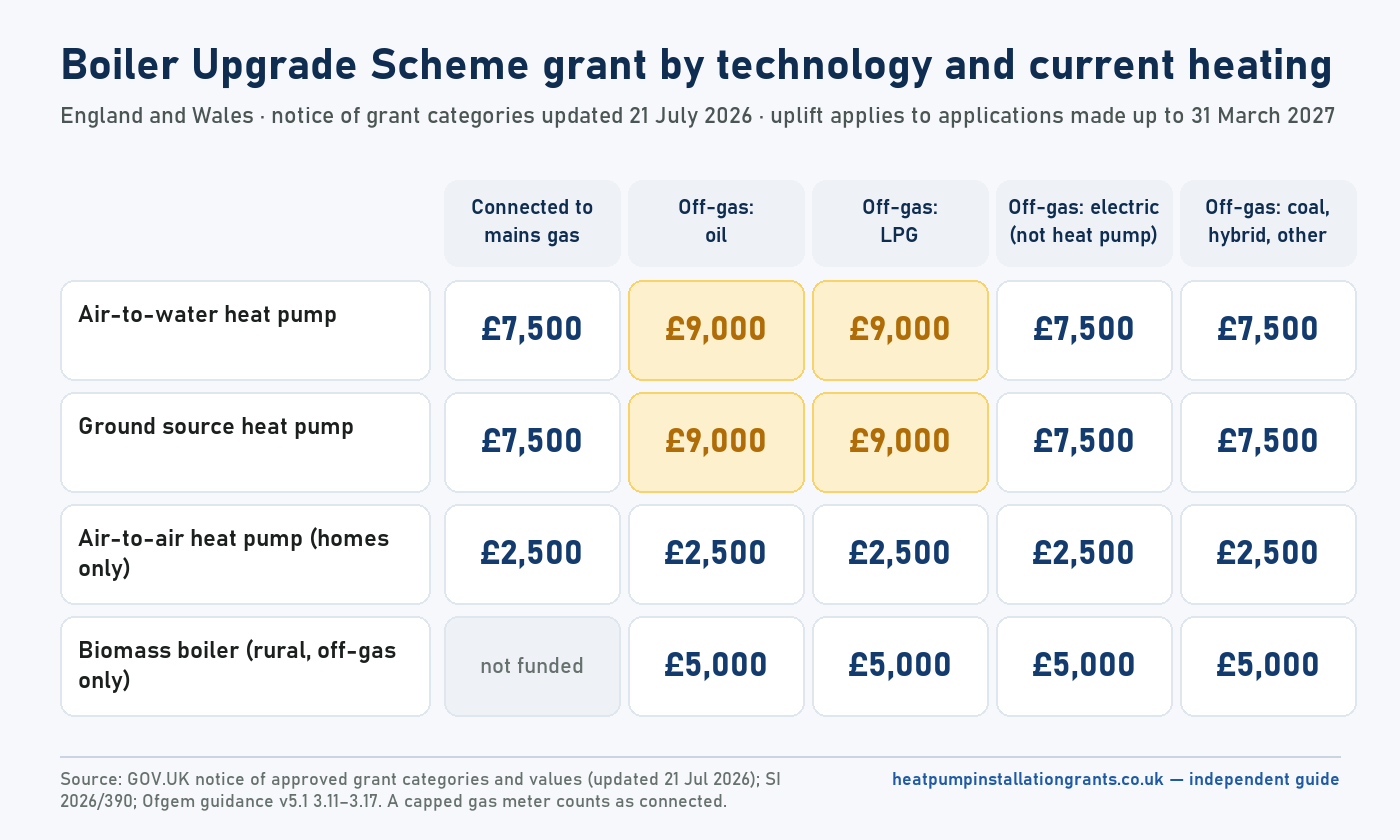
Ofgem's guidance sets out the higher grant as two conditions that must both be met. From 21 July 2026 the £9,000 is available where the property is:
- not connected to the gas grid, and
- replacing a heating system fuelled by oil or liquefied petroleum gas (LPG),
with either an air-to-water or a ground source heat pump. GOV.UK describes the same thing as an additional £1,500 on top of the £7,500 through March 2027. Everything else is the same as the standard grant: you must own the property in England or Wales, fully replace the old system, and use an MCS-certified installer. If you want the wider rules first, read the eligibility guide.
The extra £1,500 is time-limited, so check the Boiler Upgrade Scheme end date and budget before you plan the work around it. Comparing against your current oil bills? See heat pump vs oil boiler running costs.
Does the £9,000 band apply to your home?
Six quick answers; contact details are optional and only needed if you want us to reply by email. Indicative only — your MCS installer checks eligibility and Ofgem makes the decision.
Likely £7,500
Owner-occupied home in England on mains gas replacing the boiler with an air-to-water heat pump.
Rules: GOV.UK “Apply for the Boiler Upgrade Scheme” and Ofgem’s property owner guidance (v5.1). Grant bands from the notice of grant categories updated 21 July 2026.
What "off-gas" means to Ofgem
For the scheme, off the gas grid means the property is not fuelled by mains gas, has no record of an existing gas meter point, is not attached to a heat network and is not a new build. A capped or clamped meter still counts as mains gas.
The second condition catches people who once had gas and then switched to oil or LPG. If a meter point is on record, the home is not off-gas for this purpose, whatever it burns today. A home that was never connected, and has always run on kerosene or bottled or tank LPG, is the clear case.
The region where this band matters most is the South West, where more installs replaced oil or LPG than anywhere else in England; see heat pump grants in the South West.
Who gets £9,000 and who does not
| Situation | Grant | Why |
|---|---|---|
| No gas, replacing oil, air source or ground source | £9,000 | Meets both conditions |
| No gas, replacing LPG, air source or ground source | £9,000 | Meets both conditions |
| No gas, replacing storage or panel heaters | £7,500 | Electric is not oil or LPG |
| No gas, replacing coal or solid fuel | £7,500 | Not oil or LPG |
| Oil-heated, but a gas meter point is on record | £7,500 | Not treated as off-gas |
| New build | Not eligible | New builds are excluded |
| Oil or LPG, moving to an air-to-air heat pump | £2,500 | The higher band is for air-to-water and ground source only |
| Oil or LPG, moving to biomass | £5,000 | Biomass has its own band |
Evidence your installer needs
The installer must show that the property meets the test. Where there is an EPC, it can help. Where there is none, which is no longer a barrier to a grant, the installer can use recent fuel bills and photographs of the existing oil or LPG system. You can make this quick by keeping hold of delivery notes, tank photographs and the last couple of invoices before the survey. It is also worth asking the installer to state the grant band on the quote in writing, with the reason. That sets the expectation early and means a mistaken assumption is caught before you sign rather than after.
If an installer will not show the grant as a line deducted from the price, that is a warning sign, since upfront deduction has been mandatory since 28 April 2026. The quote checklist covers what a good quote contains, and MCS installers explains how to verify certification.
The dates: applications, not installations
The higher grant is available for applications properly made between 21 July 2026 and 31 March 2027. What counts is when the installer's voucher application is properly made, not the day the heat pump is switched on. Once a voucher is issued the installer has 3 months to finish an air source job, or 6 for ground source. Practically, the survey, design and quote need to be finished in time for the installer to apply by 31 March 2027. Because VAT on installation in a home is 0% until 31 March 2027, the two dates coincide, but they are separate rules. This is not a countdown, only a published edge: end date and budget lays out each date and what it controls.
Worked example: what £9,000 leaves you to pay
The government benchmark is the median installed cost of grant-funded jobs in 2026 Q3, which includes the grant: £12,826 for air source and £34,630 for ground source. After £9,000 that leaves £3,826 for air source and £25,630 for ground source, against £5,326 and £27,130 on the standard grant.
A detached rural house heated by kerosene, with no mains gas and no meter point on record, receives a quote at the air source median of £12,826. The grant of £9,000 is deducted on the quote, leaving £3,826. In the running-cost model below, heating 12,000 kWh a year costs about £1,566 with the oil boiler and about £1,053 with the heat pump.
Your quote, your fuel, your numbers
No details needed. Change any figure to match your own quote or bills. Results are indicative — an MCS installer’s heat-loss survey and written quote are what count.
£5,326
Payable by you on this quote. The grant is deducted on the quote and invoice — you never receive it as cash.
Default quote = the official median installed cost for 2026 Q3 (DESNZ, published 29 October 2026), which includes the grant value. VAT on installing a heat pump in a home is 0% until 31 March 2027, then 5%.
—
Difference per year at these prices.
Prices: Ofgem cap 1 October to 31 December 2026 — electricity 26.32p/kWh, gas 7.97p/kWh, gas standing charge 29.68p/day (GB average, Direct Debit); heating oil 114.8p/litre including 5% VAT (109.3p before VAT; BoilerJuice UK average for 1,000 litres, read 28 September 2026); 10.35 kWh per litre assumed. No VAT on household electricity from 1 October 2026 to 31 March 2027, which flatters heat pumps in this window. LPG prices vary too much to default — use your own bills. Illustrative, not a quote.
Running cost against oil and LPG
Off-gas is where the running-cost case is strongest, because the fuel being replaced is dear per unit of heat. On 28 September 2026, BoilerJuice's UK average for 1,000 litres of heating oil was 109.3p a litre before VAT, or 114.8p with 5% VAT added to match the cap prices. Assuming 10.35 kWh per litre and an 85% efficient boiler, that is about 13.0p per kWh of heat. A heat pump at a seasonal efficiency of 3, at the 1 October to 31 December 2026 electricity cap of 26.32p per kWh, delivers heat for about 8.8p. LPG prices vary widely by contract, so use your own bills in the calculator.
Two cautions apply. Household electricity carries no VAT from 1 October 2026 to 31 March 2027, which flatters any comparison made today. And the efficiency figure depends on design: flow temperature, radiators and controls. Ask for the design figure and its basis rather than assuming. The full comparison is on heat pump vs boiler running costs, and tariffs that can improve it are in heat pump tariffs.
The route from oil tank to heat pump
DESNZ statistics published on 29 October 2026 show 8,107 applications for the higher grant from July to September 2026, 32% of the 25,374 applications in those three months. Oil has been the fuel replaced in 18% of paid grants and LPG in 3%. For a typical rural home the practical order is: check the property against the test above, request two or three quotes that show the grant deducted, check each installer on the MCS register, then agree a survey and a design. Ofgem's consent email arrives after the installer applies, and you reply within 14 days. The application guide covers that stage, and if the house is large or the ground suitable, the ground source grant explains the other technology.
Paying the balance after the grant
The grant comes off the price before you pay anything, so the question is only how to fund what is left. These are the routes people use — this site does not arrange credit or recommend a lender.
| Route | How it works | What to check |
|---|---|---|
| Savings | Pay the balance on the installer’s payment schedule. You own the system outright. | How much deposit is asked for up front, and whether it is protected under the installer’s consumer code. |
| Mortgage further advance or green home loan | Some lenders offer borrowing earmarked for energy improvements, sometimes at reduced rates. | The representative APR, the total amount repayable and any fees — compare against simply paying from savings. |
| Installer-arranged credit | Some installers introduce a credit broker so the balance is paid monthly. | The lender must be authorised by the Financial Conduct Authority. Ask for the APR and total repayable in writing before you sign anything. |
| Scotland only | Home Energy Scotland offers an interest-free loan of up to £7,500 alongside its own grant (not the Boiler Upgrade Scheme). | Apply to Home Energy Scotland before work starts. |
A note on VAT (not a finance route): installers apply 0% VAT to a supply-and-install job in a home until 31 March 2027, and 5% after. Check the quote shows no VAT on the installation; equipment bought without installation is standard-rated.
Questions off-gas households raise
“I will wait and see if the higher grant is extended.”
You might be right, and nobody can say. The published position is that the £9,000 band covers applications properly made up to 31 March 2027, after which the same job attracts £7,500, a difference of £1,500.
If your oil boiler is healthy and you are not planning to change it, waiting costs nothing. The date only matters if you were going to switch anyway.
“My LPG is delivered by pipe from a shared tank. Am I off-gas?”
Ofgem’s test is about mains gas: the property must not be fuelled by mains gas, must have no record of a gas meter point, and must not be on a heat network. If you are unsure whether your supply counts, ask the installer to confirm before the quote is finalised.
Shared LPG networks and old capped connections are exactly where people misjudge it, so get the answer in writing.
“It will cost more to run than oil.”
In this illustrative model, not at current prices, which depend on the price cap and the electricity VAT window. At 114.8p a litre including 5% VAT (28 September 2026; 109.3p before VAT) an 85% efficient oil boiler delivers heat for about 13.0p per kWh. A heat pump at a seasonal efficiency of 3 does it for about 8.8p at the 1 October to 31 December 2026 cap.
Oil prices move, and the zero-VAT window on household electricity ends on 31 March 2027. Re-run the numbers with your own bills.