The verdict, by starting point
“Worth it” has three parts: what it costs you after the grant, what it costs to run compared with what you pay now, and whether the house and your plans suit it. We use the official median installed cost and the Ofgem cap, then say where the answer is a yes, a maybe or a no. Nothing here is a quote; it is a framework you can check.
To put your own quote and bills into the sum, use the heat pump running cost calculator.
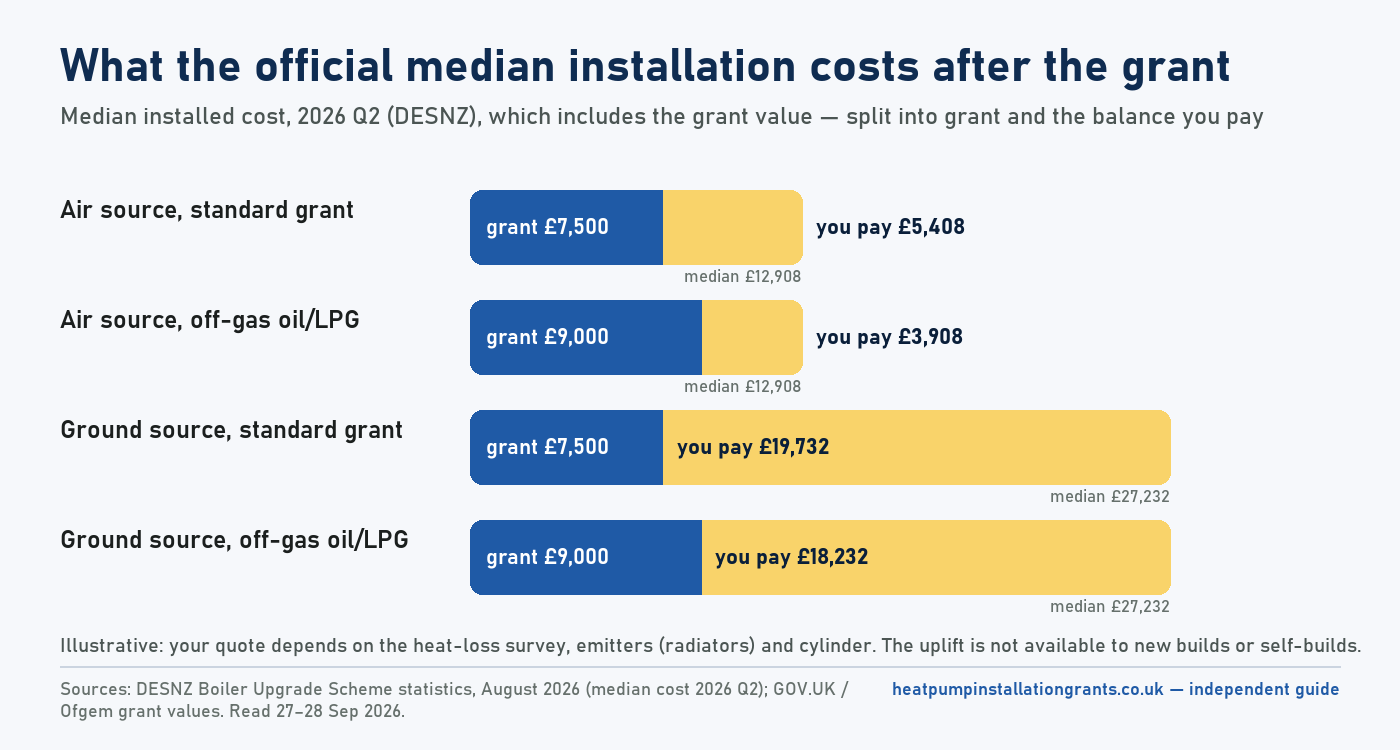
The first part, the upfront price, is set out in full on our heat pump installation cost page, including how the official medians relate to the grant and what makes a quote higher or lower.
| Replacing | Grant | Median cost after grant | Running cost against heat pump | Verdict |
|---|---|---|---|---|
| Oil boiler (no mains gas) | £9,000 | about £3,826 | Oil about £1,566 against £1,053 | Payback about 7.5 years in the model |
| LPG boiler (no mains gas) | £9,000 | about £3,826 | LPG price not in our model; typically dearer than gas per kWh, so check your bills | Check your own bills; not modelled |
| Direct electric heating | £7,500 | about £5,326 | Electric about £3,158 against £1,053 | The biggest saving; an upper bound if you are on off-peak storage heater rates |
| Gas boiler, due for replacement | £7,500 | about £5,326 | Gas about £1,063 (£1,171 with standing charge) | Maybe; depends on tariff and design |
| Gas boiler, young and working | £7,500 | about £5,326 | About level | Not on money alone |
Two caveats on that table. The “oil boiler” row is the £9,000 band, which applies only where the home has no mains gas and the heating being replaced is oil or LPG; an electrically heated off-gas home gets £7,500. And the median cost is a median: the quote on your house can be above or below. The air source cost page and the off-gas grant page have the detail.
Payback from the model
Using the median air source cost after grant and the annual fuel saving in our model, simple payback is about 7.5 years replacing oil with the £9,000 grant (saving about £513 a year), about 2.5 years replacing electric heating at the standard rate (saving up to about £2,105 a year; less on off-peak storage heater rates), and 45.1 years replacing gas if the gas supply and its standing charge are removed (saving about £118 a year). If the gas supply stays, the saving is about £10 a year and the payback on fuel savings alone is 532.6 years — in other words, fuel savings do not pay for the system, and the case rests on other things.
Simple payback ignores things that cut both ways. It leaves out the servicing a gas or oil boiler needs, the cost of the replacement boiler you do not have to buy, any change in energy prices, and any value of a lower-carbon system to you. It also assumes the heat pump reaches SCOP 3. The real-world trial measured a median of 2.78 to 2.93 for air source systems, and at SCOP 2.5 the annual cost in the same model rises to £1,263, which would remove most of the saving against gas. The takeaway is not a precise year but a direction: where the saving is £513 to £2,105 a year the numbers can work, and where it is about nothing they cannot.
Your cost after the grant, and your running cost
No details needed. Change any figure to match your own quote or bills. Results are indicative — an MCS installer’s heat-loss survey and written quote are what count.
£5,326
Payable by you on this quote. The grant is deducted on the quote and invoice — you never receive it as cash.
Default quote = the official median installed cost for 2026 Q3 (DESNZ, published 29 October 2026), which includes the grant value. VAT on installing a heat pump in a home is 0% until 31 March 2027, then 5%.
—
Difference per year at these prices.
Prices: Ofgem cap 1 October to 31 December 2026 — electricity 26.32p/kWh, gas 7.97p/kWh, gas standing charge 29.68p/day (GB average, Direct Debit); heating oil 114.8p/litre including 5% VAT (109.3p before VAT; BoilerJuice UK average for 1,000 litres, read 28 September 2026); 10.35 kWh per litre assumed. No VAT on household electricity from 1 October 2026 to 31 March 2027, which flatters heat pumps in this window. LPG prices vary too much to default — use your own bills. Illustrative, not a quote.
When a heat pump is not worth it
It is worth saying plainly, because most pages on this subject never do. A heat pump is probably not worth it, now, in these situations:
- You have a recent, efficient gas boiler that works. The running cost is about level, the grant does not close the gap, and the boiler has years of life. Waiting for the natural replacement point costs you little. The grant is due to run until 30 December 2029, subject to the annual budget.
- You are likely to move within a few years and would not recover the cost in a sale price. We have no sound figure for how much a heat pump adds to value, so do not count on it.
- There is nowhere sensible for the outdoor unit, or the siting would breach noise limits in a tight terrace. The trial found 5% of properties where the unit could not meet permitted development noise criteria, mostly mid-terraces. See planning permission and flats and terraces.
- You rent, and the landlord has not agreed. The grant is for the property owner, who must consent.
- You can only get poorly designed quotes. A heat pump that runs at SCOP 2.5 can cost more than gas, so no design basis means no deal. Use the quotes checklist.
- The home is a new build, which is generally excluded from the grant; self-builds can qualify. See eligibility.
Beyond the running cost
Money is not the only reason people switch, and it is not the only cost. Several things sit outside the simple sum:
- Comfort and control. Heat pumps run for long periods at lower temperatures, so radiators feel warm rather than hot. In the Electrification of Heat trial, 85% of participants said after a heating season they had already recommended one or probably would.
- Carbon. Replacing fossil heating cuts the emissions of your home’s heating, and a lower-carbon grid improves that over time. We do not put a number on it here because it depends on the grid mix of the year.
- Disruption. Installation is a few days of work, a cylinder and pipework changes, and sometimes radiator replacements. See the installation process.
- Future-proofing. A heat pump may also pair with solar and a battery. That is a possibility, not a measurement.
- Hot water. Most installs need a hot water cylinder, which takes space. See the cylinder guide.
How to decide for your house
- Write down your current annual heating spend from bills (separate cooking if it is on gas).
- Check the grant you would get: £7,500 generally, £9,000 for qualifying oil and LPG homes (see eligibility).
- Get two or three written quotes showing the heat loss, the design flow temperature, the SCOP and its basis, and the grant taken off the price.
- Use the calculator above with the quoted price and your own bills, then change the efficiency to 2.5 and see whether the answer survives.
- Mind the clocks: the £9,000 band ends for applications after 31 March 2027, and VAT on installation moves from 0% to 5% from 1 April 2027. See end date and budget. These are dates to plan around, not deadlines that should drive the decision.
Common doubts about whether it is worth it
“If it only matches gas on running cost, why would anyone bother?”
Because for many households the running cost is not the reason. The grant brings the installed price of an air source heat pump from a median of £12,826 to about £5,326, a boiler at end of life has to be replaced with something, and a heat pump removes the gas standing charge if the supply goes. Those can matter more than a few pounds a year of fuel.
If your gas boiler is young and working, none of that is urgent, and you lose nothing by waiting for the next natural replacement point.
“Will it actually keep my house warm?”
In the Electrification of Heat trial, participants reported that the heat pump kept the home warm, was reliable and was easy to use; 85% said after a heating season that they had already or were likely to recommend one to friends or family (December 2024 summary report). A right-sized system designed from a proper heat-loss survey is built to hold the design temperature in cold weather.
The trial also found a wide spread in measured efficiency and some less happy households. Design quality is the variable to check.
“Should I wait for prices to fall?”
Official medians show the air source price falling in real terms: 14% lower than in 2022 Q3. But the deadlines are real: the £9,000 oil and LPG band applies to applications up to 31 March 2027, and VAT on installation moves from 0% to 5% on 1 April 2027. Both are worth putting on the calendar, and neither should override a decision that does not stack up for your home.