The sequence at a glance
A heat pump installation is a project with a paper trail, and the grant adds a few fixed steps. The table gives the order and what you should hold at the end of each stage. The detail follows, with the checks worth making.
| Stage | Who acts | You should receive or do |
|---|---|---|
| 1. Survey and heat-loss calculation | Installer | The calculation, or at least its result, and a list of what was measured. |
| 2. Design and written quote | Installer | A quote showing the unit, flow temperature, emitter work, the grant deducted and your balance. |
| 3. Application, consent and voucher | Installer, Ofgem, you | Ofgem’s email asking you to confirm consent; your reply within 14 days. |
| 4. Installation | Installer | A schedule, with the days the heating and hot water will be off. |
| 5. Commissioning and MCS certificate | Installer | Commissioning records and the MCS certificate for the installation. |
| 6. Handover and grant claim | Installer, Ofgem | Instruction on the controls, warranties, and an invoice showing the grant deducted. |
If you are still choosing a firm, begin with how to find and compare heat pump installers. If you are not sure the grant applies to your home, check the eligibility rules first, or use the quick checker at the end of this page.
The first visit is the survey, and what happens at a heat pump survey lists what it should cover and how to prepare for it.
1. Survey and heat-loss calculation
The survey is the foundation of the project. The Energy Saving Trust’s installer toolkit describes an accurate room-by-room heat-loss calculation as fundamental to ensuring a heat pump can provide adequate heating throughout a property (read 8 October 2026), and the MCS standards library lists a dedicated Heat Pump Design Standard, MIS 3005-D, issued in its 2025 edition (version 2.0, December 2025). The data an installer is expected to collect, according to the toolkit, includes the internal design temperatures, air change assumptions, fireplaces, exposure, floor area and room heights, along with wall types, windows, insulation thickness and a candidate position for the outdoor unit.
Practically, that means someone walking through every room with a tape measure and taking notes, not glancing at the boiler. Be present if you can, and mention rooms you find cold, any extensions, and any planned works such as new windows or loft insulation. Those details change the answer.
Ask for the result in writing. If an installer cannot tell you the house’s heat loss in kilowatts, it is hard to see how they have sized the unit.
2. Design and quote
From the survey, the installer chooses a unit and designs the water temperature the system will run at, the emitters that can deliver it, and the hot water arrangement. Lower flow temperatures generally suit heat pumps better, which is why radiator upgrades appear on many quotes. The result is a written quote.
This is the moment to apply the quotes checklist: check the certified company, the unit, the heat-loss figure, the flow temperature, an itemised list of radiator, pipework, cylinder and electrical work, and the grant line. Ofgem’s guidance and GOV.UK say the grant must be deducted from the price on the quote and the invoice. For radiators and flow temperature in more detail, see heat pump sizing and radiators; for the cylinder, hot water cylinders.
The design also fixes where the outdoor unit goes. In England, air source heat pumps can be installed under permitted development if they meet the conditions, which include a noise assessment under MCS 020 a); the figure to meet is 37.0 dB(A). The installer should say whether your site qualifies and what changes if it does not. The detail is on the planning permission page.
3. Application, consent and voucher
Under the Boiler Upgrade Scheme, the installer applies to Ofgem on your behalf. Ofgem then contacts you to confirm that you have consented to the installer applying for you. Ofgem’s property owners page (read 8 October 2026) says you have 14 calendar days to confirm consent once Ofgem emails you after the application, and it explains that confirming consent does not lock you into a contract. Once the application is approved, a voucher is issued. It is valid for 3 months, or 6 months for a ground source heat pump, within which the installation must be commissioned and the grant redeemed.
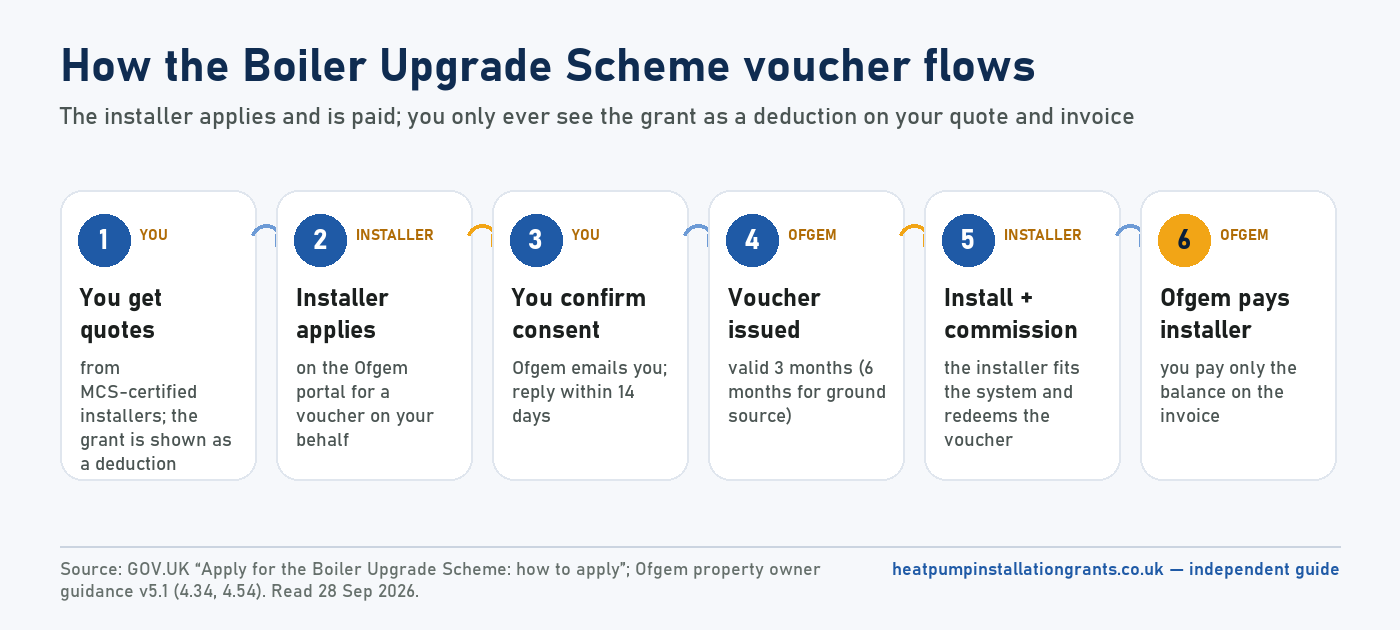
Retrospective applications are possible within 120 days after commissioning, but Ofgem says they carry additional risk, since there is no guarantee the grant will be paid. A voucher obtained before the work starts is the safer sequence. The how to apply page explains this in full, including what to do if Ofgem’s email has not arrived.
4. Installation
The work itself covers positioning the outdoor unit on a base or bracket, running refrigerant or water pipework, fitting or replacing the cylinder if needed, changing radiators where the design calls for it, connecting the electrics and controls, and removing the old boiler. Systems differ, so this site does not state a number of days as fact: ask the installer for a schedule that names the days, the trades involved and the periods without heating or hot water.
- Agree access, parking and where materials will be stored.
- Check where the condensate and any defrost water will drain, and where the outdoor unit’s noise will fall relative to neighbours’ windows.
- Ask who will be on site, and whether any part is subcontracted.
- Confirm what happens to the old boiler and tank, and whether the quote includes making good.
Ground source systems add a ground loop, with trenches or a borehole, which extends the project and is covered by the longer 6-month voucher. See ground source heat pump grant.
5. Commissioning and the MCS certificate
Commissioning is where the installer sets up, tests and balances the system and proves it works as designed. It is separate from the day the unit is first switched on. Ask for the commissioning record and what settings were chosen for the heating curve and hot water schedule. The installer registers the installation so that an MCS certificate can be issued. That certificate is part of the paperwork Ofgem can ask for, and it is the document you will want if you sell the house or make a warranty claim.
Do not pay the final balance until commissioning is complete and you hold the paperwork, unless your contract sets out stage payments that say otherwise. The payment terms and deposit protection are what a consumer code is for; the complaints guide explains the route if the final stages go badly.
6. Handover and the grant claim
At handover the installer should show you the controls, explain how to set hot water and heating schedules, and leave the warranty documents, the manuals and the invoice. The invoice must show the grant deducted. The installer redeems the voucher with Ofgem; you do not apply for payment. Keep the quote, contract, invoice, proof of payment, MCS certificate and commissioning record in one folder, since Ofgem may audit installations.
It is worth asking, before you sign, what the installer provides after handover: whether they will check settings after a first heating season, and how to reach them if something is not right.
Timing: what is fixed and what is not
| Item | Fixed by the scheme? | Figure |
|---|---|---|
| Your consent to Ofgem | Yes | 14 days (Ofgem’s consent check) |
| Voucher validity, air source and biomass | Yes | 3 months |
| Voucher validity, ground source | Yes | 6 months |
| Retrospective application window | Yes | 120 days after commissioning |
| Length of the survey | No | Depends on the house and the installer |
| Days of installation work | No | Ask for a written schedule |
| Wait for an installer’s start date | No | Depends on the installer’s diary |
The grant budget is set each year and runs on a first-come, first-served basis, with scheme applications closing on 30 December 2029; the end date and budget page has the current figures. That is a reason to plan, not to rush a design. The real dates to watch are the end of the £9,000 off-gas band for applications after 31 March 2027, and the change in VAT on installation on 1 April 2027; the VAT page covers the latter. On cost, £12,826 is the 2026 Q3 median for an air source system including the grant value, and the cost guide breaks it down.
Which grant would apply to you?
Six quick answers; contact details are optional and only needed if you want us to reply by email. Indicative only — your MCS installer checks eligibility and Ofgem makes the decision.
Likely £7,500
Owner-occupied home in England on mains gas replacing the boiler with an air-to-water heat pump.
Rules: GOV.UK “Apply for the Boiler Upgrade Scheme” and Ofgem’s property owner guidance (v5.1). Grant bands from the notice of grant categories updated 21 July 2026.
Worries at the start of a project
“I need heating sorted quickly, so I cannot wait for a survey and design.”
The design stage is where a heat pump is made to work in your house, so skipping it is the one shortcut that costs more later. If your boiler has failed, ask installers what temporary arrangements they would suggest while the proper work is planned.
A broken boiler in winter is stressful. A rushed system that struggles to heat the house is a longer problem than a short wait.
“Installation will turn my house upside down.”
Expect some disruption: the outdoor unit goes in, pipework changes, radiators or a cylinder may be replaced, and heating and hot water will be off at some point. Ask the installer to set out which days involve what, and when the heating will be off.
“I do not need to be involved once I sign.”
You do. Ofgem emails you to confirm you consented to the application and expects a reply within 14 days. If you do not respond, the application can stall.