Why a heat pump needs a cylinder
A gas combi boiler heats mains water as it flows through, with a very high output for a short time. A heat pump works at a much lower output over a longer time, so it heats water in advance and keeps it in a storage cylinder. The government’s heat pump guidance puts it simply: if you do not already have one, your heat pump will need a hot water storage unit like a cylinder. If the home already has a cylinder and system boiler, the installer will check whether it can be reused. If it was on a combi, a cylinder is new equipment and a new space requirement. Ofgem’s guidance for property owners says installers should explain how the installation will affect your home, with heat emitters and space requirements as its examples, so the question belongs in your first conversation.
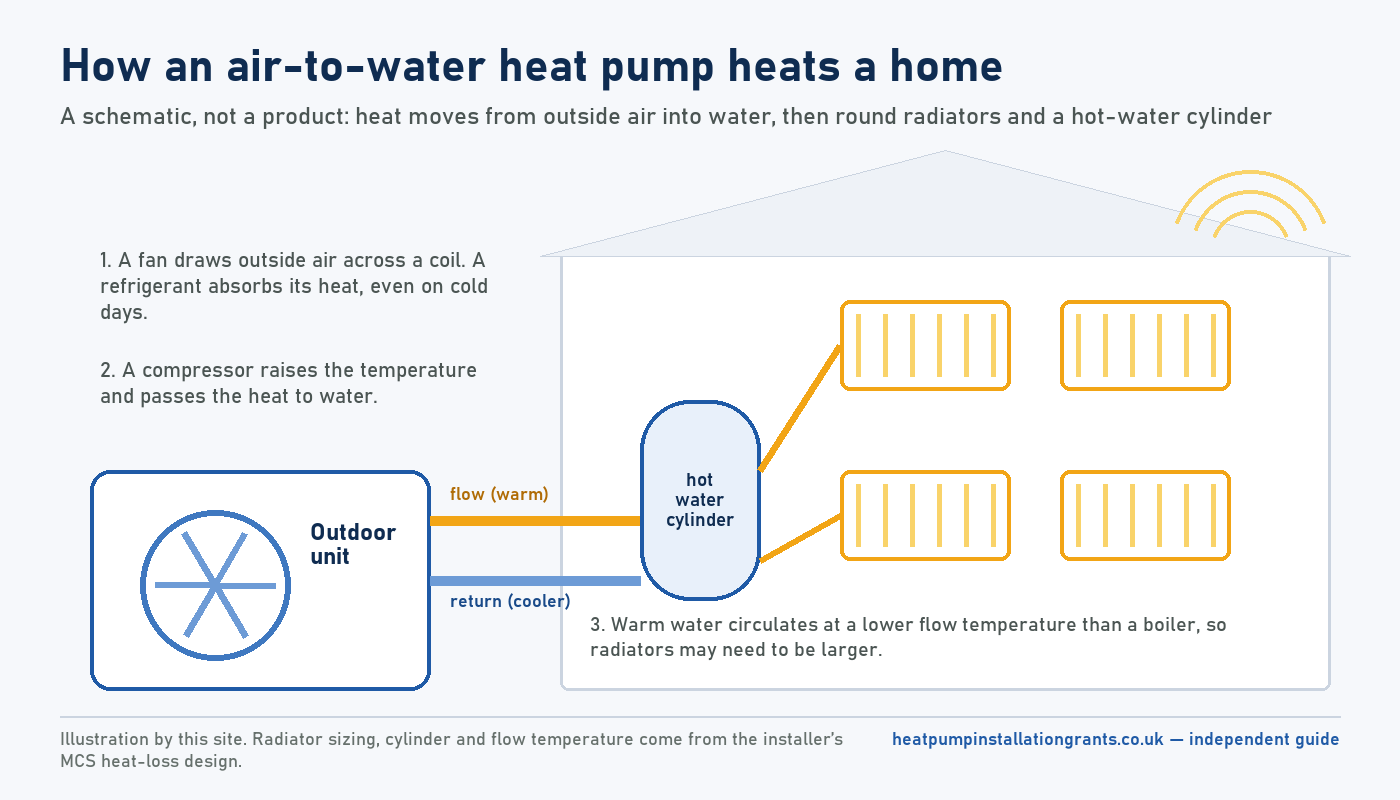
The cylinder also has a cost in efficiency. Hot water needs a higher temperature than space heating, and heat pumps are less efficient when producing it, which the DECC study gives as the reason it matters so much to look at cylinder losses. This is also why your running costs depend on the cylinder: see running costs against a boiler.
What size: the test data
There are plenty of rules of thumb for cylinder size online. The best public evidence in the UK is a laboratory programme carried out by Kiwa for the then Department of Energy and Climate Change in 2013, which tested cylinders of 150, 180 and 250 litres on heat pump operating modes. It is old, so treat it as the shape of the trade-off rather than a specification, but its reasoning is still the clearest on the public record.
- Custom and practice. The study says 120 litres at 65°C has been regarded as sufficient for a typical three-bedroom house. That is a boiler-era figure, because heat pumps store at lower temperatures.
- Lower temperature means more litres. The cylinder volume needs to be larger at lower temperatures to give a satisfactory number of consecutive large draw-offs.
- The compromise. Assuming a standard 88 litre bath at 40°C, with cold water at 10°C, two consecutive baths would need 150 litres of storage at 50°C and more than that at 45°C. The study concluded a 150 to 160 litre cylinder is a reasonable compromise, with 180 litres possibly needed for families of more than two adults storing at around 45 to 50°C.
- Bigger is not better by default. The 250 litre cylinder was judged unnecessary for the draw-off patterns used, and the smaller cylinders performed better at very low use. The main reasons for going above 180 litres were solar thermal panels or high hot water use on an off-peak tariff.
The table gives the number of consecutive 88 litre baths from each cylinder, assuming a well-stratified tank (hot water drawn off the top while cold enters the bottom). These are the study’s Table 17 figures.
| Storage temperature | 120 litres | 150 litres | 180 litres | 250 litres |
|---|---|---|---|---|
| 65°C | 2.50 | 3.13 | 3.75 | 5.21 |
| 60°C | 2.27 | 2.84 | 3.41 | 4.73 |
| 55°C | 2.05 | 2.56 | 3.07 | 4.26 |
| 50°C | 1.82 | 2.27 | 2.73 | 3.79 |
| 45°C | 1.59 | 1.99 | 2.39 | 3.31 |
The same study modelled the worst case, a completely mixed tank, and found far fewer baths: a 150 litre cylinder at 60°C gave 1.14 baths and at 50°C 0.57. Real tanks sit between the two, so the stratification and the position of the pipe connections matter, which is a good reason to prefer a purpose-made heat pump cylinder to a repurposed old one.
Worked example: a four-person home
Take a household of two adults and two children who regularly run back-to-back baths and showers in the morning. Using only the Kiwa table above: a 150 litre cylinder stored at 50°C delivers about 2.27 consecutive baths if the tank stratifies well, and 0.57 if it mixes. A 180 litre cylinder at 50°C gives about 2.73. Raising the storage temperature to 60°C lifts the 150 litre figure to 2.84, but a higher store temperature makes the heat pump work harder for hot water. This household is the sort the study had in mind when it said families of more than two adults may need 180 litres at lower storage temperatures. It is arithmetic on published test data, not a design for any specific home.
Your own pattern matters more than the head count: a household that showers briefly and never baths needs far less than one that fills a bath each evening. Tell the installer what actually happens in the house.
Legionella: the 60°C cycle
Legionella bacteria multiply in warm water and are controlled by temperature. The Health and Safety Executive’s guidance says hot water should be stored at at least 60°C and distributed so that it reaches 50°C within 1 minute at the outlets. HSE’s temperatures are written for workplaces and rented premises; for your own home, follow the manufacturer’s and installer’s disinfection settings, and do not disable the cycle or lower the stored temperature without asking them. A heat pump’s compressor cannot readily reach the highest temperatures efficiently, so installations run a periodic disinfection cycle. The Energy Saving Trust’s installer toolkit describes the usual arrangement: the compressor takes the stored water to roughly 55°C and then the immersion heater lifts it to a higher temperature for a set time, for example 60°C for 60 minutes, with the normal comfort setpoint much lower, around 48°C.
Two cautions follow from that. First, the cycle should be set up and left running: switching off the immersion to save a few pence defeats the safeguard. Second, the Kiwa study found that the bottom of the cylinder did not reach 60°C even with the immersion on for three hours set to 65°C, and so suggested sterilisation cycles be carried out during the night with other methods investigated. It is worth asking the installer how their cylinder and cycle ensure the whole volume is disinfected and when the cycle runs. Questions like this are worth putting at the survey; how to find and compare installers explains how to arrange it.
There is one safety limit in the other direction. Part G of the Building Regulations requires that the hot water supply to any fixed bath is designed so that the water delivered to it cannot exceed 48°C. Hot water stored at 60°C is therefore mixed or limited at the bath tap, and the limit device must not be easy for occupants to alter.
Unvented cylinders and the Building Regulations
Mains-pressure cylinders are called unvented because they have no open vent pipe to a tank in the loft. Approved Document G (2015 edition incorporating 2024 amendments, in effect 1 October 2024) says an unvented storage system should have at least two independent safety devices, in addition to its thermostat, and that systems up to 500 litres and under 45 kW should be a proprietary unit or package meeting a recognised standard, with the operating pressures and safety devices marked on it. The requirement is that the stored water can never exceed 100°C and any discharge is conveyed safely to where it is visible.
You do not need to know the standards; you need to know the work should be done by a registered competent person, who certifies it, and who gives you a certificate within 30 days under the Regulations. Ask for it at handover along with the MCS certificate that the grant depends on: how to check an MCS installer explains the register.
Where it goes and the space-saving options
Cylinders are tall and need clearance for the pipework and a service space. Where the installer puts it matters beyond fit: the DECC study highlighted that heat pump cylinders are often stored outside the heated envelope, which increases losses, and recommended minimising primary pipework and increasing its insulation, since pipework that stays hot while the pump runs adds to the loss. In practice:
- Inside the heated part of the house (an airing cupboard, utility room, or under-stair space) usually keeps the losses useful.
- Short insulated pipe runs between the heat pump and the cylinder cut heat loss.
- A smaller cylinder costs less space and standing loss, at the price of fewer back-to-back draws; the study judged 150 litres a reasonable compromise.
- A heat battery is the space-saving alternative the government explainer mentions for homes with limited space. It is a different product with different trade-offs, so ask any installer who proposes one for the figures.
If you live in a flat or a terraced house, space is often the binding constraint inside as well as outside: see heat pumps for flats and terraces.
What the cylinder does to the quote
A cylinder is part of the installed price, and so part of the number the grant is set against. The Energy Saving Trust gives around £12,000 for a typical air source heat pump (page updated 23 September 2026), and the official median installed cost for 2026 Q3, including the grant value, is on air source heat pump cost after the grant. This guide does not quote a price for the cylinder because none of the official sources it relies on does; ask each installer to show it as a separate line with its litres, make and any enhanced insulation, so you can compare like with like. Try the calculator against a real quote.
What the quote leaves you to pay after the grant
No details needed. Change any figure to match your own quote or bills. Results are indicative — an MCS installer’s heat-loss survey and written quote are what count.
£5,326
Payable by you on this quote. The grant is deducted on the quote and invoice — you never receive it as cash.
Default quote = the official median installed cost for 2026 Q3 (DESNZ, published 29 October 2026), which includes the grant value. VAT on installing a heat pump in a home is 0% until 31 March 2027, then 5%.
What to check on the quote
- The cylinder’s volume in litres, whether it is new, and the proposed storage temperature.
- Where it goes, and the length and insulation of pipework to the heat pump.
- Whether the design allows for the number of people and the way you use hot water.
- The disinfection cycle: temperature, duration, timing, and whether the immersion is included.
- That the installer is registered with a competent person scheme for unvented work, and will give you a certificate.
- What the alternative is if space is tight.
For the wider checklist see what a good quote must include, and for the order of events on site the installation process.
Hot water worries, answered
“I have a combi boiler and no space for a tank.”
A heat pump does not make hot water on demand the way a combi does, so it needs somewhere to store it. The government’s own explainer says heat batteries are an option for people with limited space. Ask each installer where they would put a cylinder, what size, and what the alternative is if the space is tight.
Where there truly is no room anywhere in the house, a heat pump may not suit the property; the survey is how you find that out before you commit.
“Storing hot water just wastes energy.”
Standing losses are real, and the 2013 study for the Department of Energy and Climate Change found they dominate the efficiency of a stored hot water system. That is why it recommends the smallest cylinder that still satisfies the household and keeping stored temperatures as low as the safety rules allow.
A bigger cylinder than the household needs does cost energy every day.
“Heating the water to 60°C will wreck the heat pump’s efficiency.”
Only a short cycle does that. The Energy Saving Trust’s example runs the heat pump compressor up to about 55°C and uses the immersion heater for the extra, for example 60°C for 60 minutes, as a periodic disinfection cycle, with the normal comfort setpoint around 48°C the rest of the time.
Hot water is always the least efficient thing a heat pump does, because it needs higher temperatures than the radiators.