Who protects you, and how
A heat pump purchase with the Boiler Upgrade Scheme involves several bodies with different jobs, and sending a complaint to the wrong one is the commonest reason it goes nowhere. Think of three layers, plus general consumer help behind them.
- MCS certifies installation companies for named technologies against technical and quality standards, and issues a certificate for each installation. Its register shows who is certified and through which certification body.
- A consumer code governs how the installer deals with customers: contracts, deposits, selling practice and disputes. Ofgem requires installers working with consumers to belong to an approved code.
- Ofgem administers the grant: it approves vouchers, checks and audits installations, and pays installers.
- Citizens Advice and Trading Standards give general consumer advice and take reports about trading practices, including scams.
Before any of them can help, you need to know which problem you have. A late or faulty installation is for the installer and their code. A grant that was not deducted is for Ofgem. A cold caller using the scheme’s name is a matter for the scams routes. Heat pump grant scams covers the last one.
The three consumer codes
| Code | What it says about itself (read 8 October 2026) | Where to look |
|---|---|---|
| RECC | Sets consumer protection standards for businesses selling renewable energy systems, including heat pumps, to domestic customers. Approved by the Chartered Trading Standards Institute. Describes deposit and workmanship-warranty protection and a complaints process. | recc.org.uk |
| HIES | An accreditation scheme for home energy installers. Describes deposit and stage-payment protection and insurance-backed guarantees, an alternative dispute resolution scheme, and operation under a CTSI-approved consumer code. | hies.org.uk |
| MCS consumer code | The Secretary of State approved the MCS code on 1 June 2026, so an installer can now meet the scheme’s consumer code condition through MCS itself. | mcscertified.com |
The detail of what each code requires and covers is in the codes’ own documents, which this page does not reproduce. Read the one that applies to your installer before you sign, ask which protections apply to your job, and check the firm in that code’s directory; the MCS installer check covers the steps.
Evidence to keep
Every complaints route will ask for the same documents, and Ofgem expects you to keep them anyway for audit. Put them in one folder from day one.
- The written quote or quotes, including the one you accepted.
- The signed contract and any variations, in writing.
- Invoices and proof of every payment, with dates.
- Ofgem’s consent email and your reply.
- The MCS certificate and commissioning record.
- Warranty documents for the product and the workmanship.
- Photographs of the problem, dated, plus a log of calls, visits and messages.
Where to go, by problem
The installation, the design or the installer’s behaviour
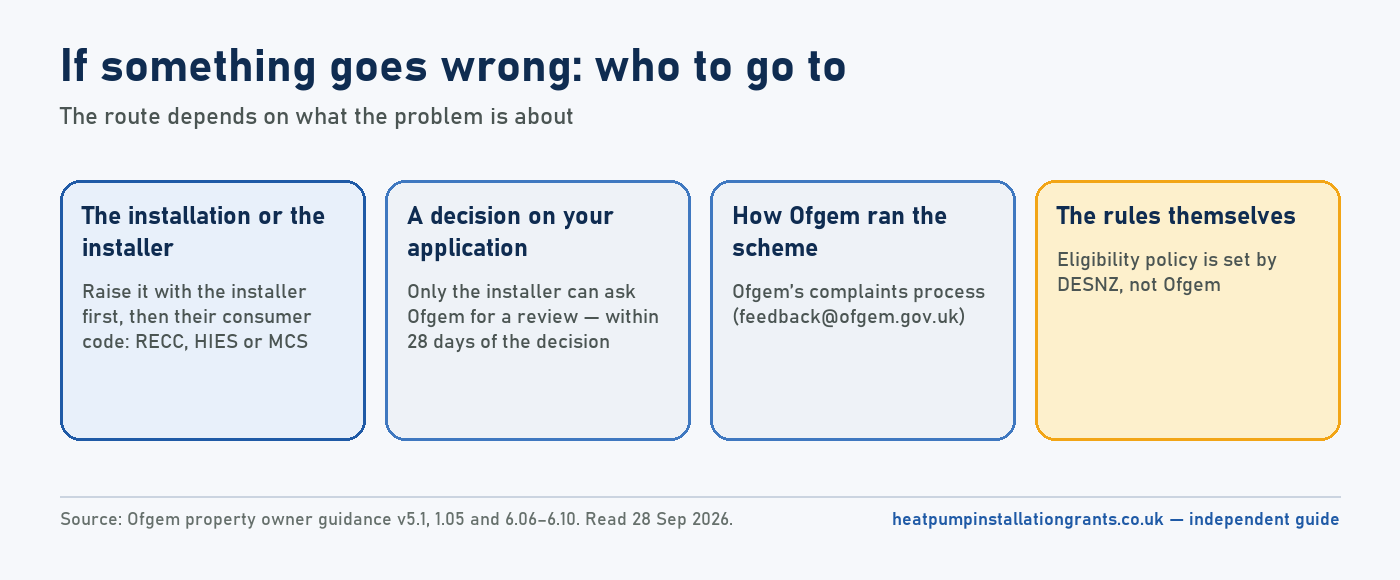
Write to the installer. Describe the problem, attach evidence, say what you want done and give a reasonable date. Keep the tone factual. If the installer does not resolve it, take the same file to the consumer code, which will tell you what it needs. Technical standards concerns can be raised through the certification body shown against the installer on the MCS register.
The quote, the pressure or the sales practice
If the problem is how you were sold to, such as pressure on the doorstep, a misleading claim about savings or a contract you were rushed into, the consumer code’s selling-practice rules are the relevant ones, and Citizens Advice can explain your rights on cancellation and misleading claims.
A deposit lost or an installer gone
Contact the code and, if you were told you had an insurance-backed guarantee, the guarantee provider named in your paperwork. If you paid by card, your card provider may be worth contacting as well; Citizens Advice can explain what protections apply to your payment method.
Heat pump performance
If the system works but the house is cold or the bills are higher than expected, ask first for the commissioning record and the design calculation. Many such issues trace to a design or settings problem that can be fixed. Some are a mismatch between the promise and the facts; the running costs guide shows what to expect from dated tariffs.
When the grant is the problem
The scheme requires the grant to be deducted from the price upfront, and the installer is not to ask you to pay it unless the application is refused or the voucher revoked. If your quote or invoice does not show the deduction, tell Ofgem, using the contact details on its own website. If a grant decision goes against you, you cannot ask for a review yourself: only the installer can, within 28 days of the notice. That is why it matters what your contract says about a refused application. Ofgem permits retrospective applications within 120 days of commissioning, but describes them as carrying additional risk, since the grant is not guaranteed to be paid.
Complaints about how Ofgem handled something go through Ofgem’s own complaints process, and complaints about the rules, such as a property type being excluded, are for the Department for Energy Security and Net Zero, not Ofgem. For the rules themselves, see eligibility and what the grant does not cover.
Escalation order
- 1
Installer, in writing
State the problem, the evidence and your deadline. Keep a copy.
- 2
Consumer code
RECC, HIES or the MCS code, whichever the installer belongs to, with your file.
- 3
Standards or grant bodies
MCS through the certification body for technical standards; Ofgem for grant deduction and fraud concerns.
- 4
Advice and enforcement
Citizens Advice for your rights and the consumer service, and Trading Standards for trading-practice concerns.
If you are still weighing up installers, the best complaint is the one you never need to make. Finding and comparing installers and the quotes checklist are the preventative steps, and how to apply shows how the grant paperwork should run.
Doubts that stop people complaining
“The consumer code is run by the industry, so it will side with the installer.”
Codes exist to set standards for members and to provide a dispute route. RECC describes itself as approved by the Chartered Trading Standards Institute, and HIES says its accredited installers operate under a CTSI-approved consumer code and offers an alternative dispute resolution scheme. Use the route, keep your evidence, and escalate if it does not resolve the matter.
No complaints scheme guarantees the outcome you want. What it gives you is a structured process and an independent step beyond the installer.
“Ofgem will sort out a poor installation.”
Ofgem runs the grant. It is not the body for a dispute about workmanship. That goes to the installer, then to the consumer code, with technical standards concerns raised through the installer’s MCS certification body.
Ofgem is the right contact for problems with the grant itself, such as a quote that did not deduct it.
“I am out of time to complain.”
Time limits vary by code and by legal route, so do not guess. Raise the problem in writing as soon as you notice it, and ask the code or Citizens Advice what limits apply to your case.