How installers fit into the grant
Most people searching for “heat pump installers” want one thing: a firm that will survey the house, design a system that works in it, install it and sort the paperwork. The Boiler Upgrade Scheme gives that search a hard edge. The scheme is installer-led, which means your installer applies to Ofgem on your behalf, and GOV.UK tells applicants to contact MCS-certified installers for quotes. If the company is not certified for the technology, there is no grant to apply for.
That makes the first filter easy and the second one hard. The first filter, certification, is a yes or no that anyone can check in a couple of minutes. The second, whether this particular firm will design your heat pump well, is a judgement, and it is where most of the money and comfort is won or lost. A heat pump sized or specified badly shows up as cold rooms and a high electricity bill for years. A well-designed one is dull, which is the aim.
It helps to keep the two jobs apart. Use the public registers to remove firms that cannot do the work or cannot claim the grant. Then use a survey, the written quote and a few direct questions to compare the firms that remain. The rest of this page follows that order. For the register walk-through in detail, see how to verify an MCS installer; for the line-by-line quote comparison, see the heat pump quotes checklist.
Three ways to find heat pump installers
| Route | Good for | Watch for |
|---|---|---|
| MCS “find an installer” | A neutral list of certified firms. Search by technology and by distance from your address or by region, and filter for Boiler Upgrade Scheme registration. | It is a register, not a recommendation: it shows who is certified, not who is good at your type of house. The results display each firm’s contact details, certification body and technologies. |
| Recommendation or local search | Firms with a track record in houses like yours, and neighbours who can tell you how installation week went. | A good reputation does not replace the register check. Confirm the legal company name, certification number and technology before you rely on it. |
| An enquiry service (including this site’s form) | One message with your questions. Your enquiry comes to SEO-DONS LTD, the publisher of this guide, and we reply by email. | You still find, verify and compare installers yourself; we do not vouch for any firm. |
The MCS tool is worth running even if you use another route, because it tells you what the register shows about a firm you are already considering. The tool lets you search by installer name or certification number, or by technology and location, and each result lists the certification body and the technologies the company is certified for (read 8 October 2026).
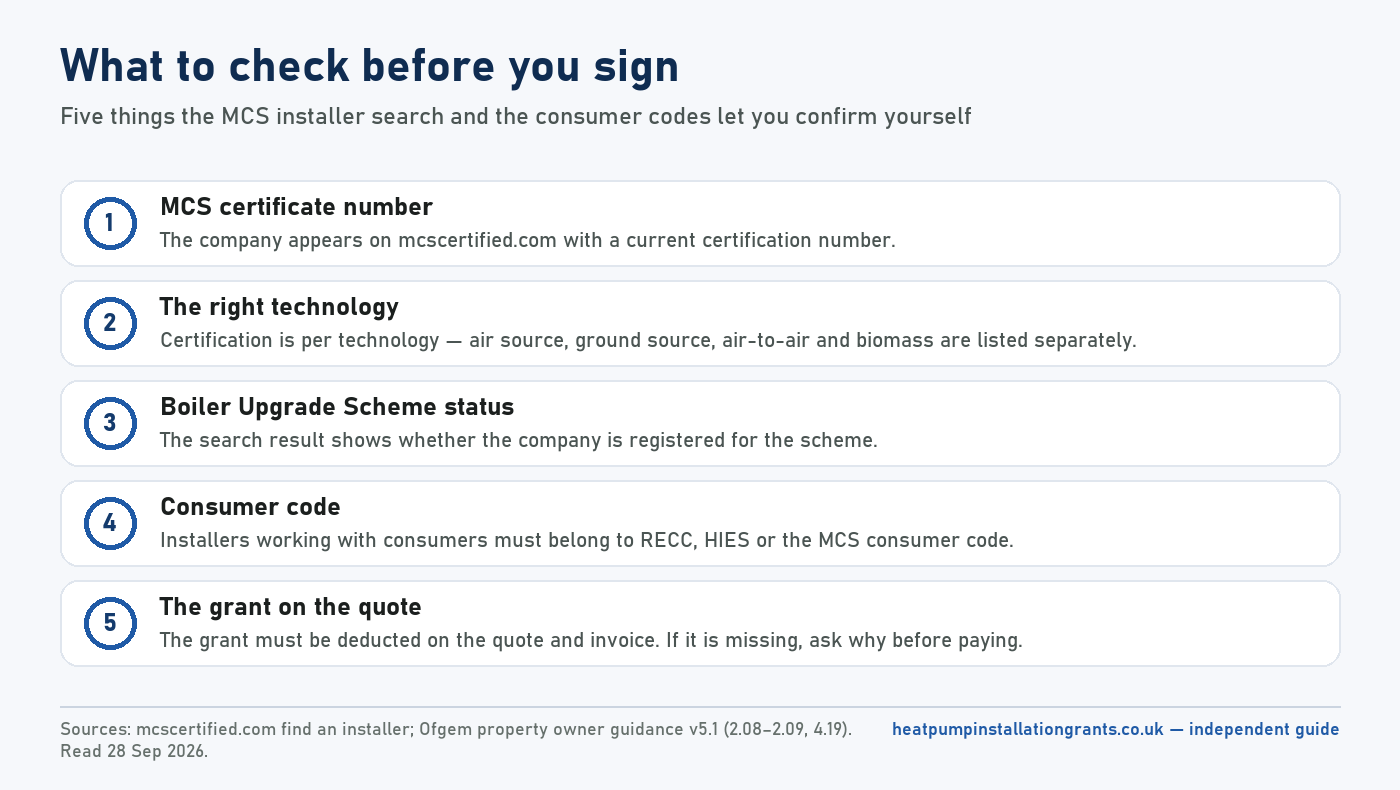
A no-contact shortlist checklist
Work through this on your own, using a company’s website, the public registers and anything they have sent you. Nothing here needs you to phone anyone or give out your details. Tick what you have confirmed; the count shows how much of the desk check is done for each firm. A firm that cannot clear the first four is not a firm to book a survey with.
Installer desk-check (for one company at a time)
0 of 10 confirmed.
What to ask each installer
The desk check removes firms that cannot do the job. These questions separate the ones that can. Put them in an email so the answers are in writing, and ask every firm the same ones so the replies are comparable.
| Question | What a useful answer sounds like |
|---|---|
| Will you do a room-by-room heat-loss calculation, and can I see it? | Yes, from a survey of the house, and it will be shared. The Energy Saving Trust’s installer toolkit describes a room-by-room calculation as fundamental to a heat pump delivering adequate heating throughout a property. |
| What flow temperature is the system designed for, and which radiators change? | A stated number, and a list of the radiators, pipework or underfloor loops affected, priced in the quote. |
| What seasonal efficiency do you expect, and on what basis? | A figure with its working shown, not a promise of savings. Treat any unexplained figure as marketing. |
| Do I need a hot water cylinder, and where will the outdoor unit go? | A specific answer for your house, including the siting of the outdoor unit with reference to the planning and noise rules. |
| Who applies for the grant, and when? | They do. The application is made before installation where possible, your consent is requested by Ofgem, and the grant is deducted on the quote and invoice. |
| How is my deposit protected, and what do the warranties cover? | Named protection under their consumer code, and separate terms for the product and the workmanship, both in writing. |
| Who will actually carry out the work? | The certified company itself, or a named subcontractor that the certified company stands behind. |
Ofgem allows a retrospective application up to 120 days after commissioning, but says that carries additional risk, because there is no guarantee the grant will be paid. A firm that wants to apply afterwards is not necessarily wrong, but you should know that is the plan and what the contract says if the grant is refused. The how-to-apply guide sets out the usual order of events.
Comparing what you are offered
Once two or three firms have surveyed, resist the temptation to line the totals up and pick the lowest. Two quotes for the same house can describe quite different systems. One might include new radiators and a cylinder; another might leave them as “to be agreed”. Compare like with like, line by line, using the quotes checklist, and test the totals against the official benchmark: the 2026 Q3 median for an installed air source heat pump was £12,826, and £34,630 for ground source, both including the grant value (DESNZ, 29 October 2026).
Those medians are the middle of the national distribution, not a price for your house, so they say whether a quote is in the usual range, not whether it is right. Use the calculator below to see where a quote sits and what you would pay once the grant is deducted.
Where does a quote sit against the official median?
No details needed. Change any figure to match your own quote or bills. Results are indicative — an MCS installer’s heat-loss survey and written quote are what count.
£5,326
Payable by you on this quote. The grant is deducted on the quote and invoice — you never receive it as cash.
Default quote = the official median installed cost for 2026 Q3 (DESNZ, published 29 October 2026), which includes the grant value. VAT on installing a heat pump in a home is 0% until 31 March 2027, then 5%.
If you are choosing between two broadly similar quotes, favour the one that explains its design. A firm that has measured the house, named its flow temperature and shown its efficiency assumption has given you something you can check later; a firm that offers a round number and a handshake has not. The installation cost guide breaks a full price into its parts.
What the enquiry form does and does not do
What it does. You give your postcode and a few details about the property and the heating you have now. Your enquiry comes to SEO-DONS LTD, the publisher of this guide, and we reply by email. We do not hand you over to a sales queue, and nothing you send commits you to anything.
What it does not do. It does not install anything, and it does not choose, rank, vet, endorse or guarantee any installer. It does not promise that a particular firm is available, what they will charge, or when they will call. It does not apply for your grant: only your chosen installer can do that. You are not committed to accept any quote.
How the site is funded. This site is free to use. Your enquiry comes to SEO-DONS LTD, the publisher of this guide, and we reply by email.
This site is published by SEO-DONS LTD as an independent guide. Because it is not an installer, everything above about checking MCS, consumer code, quote content and warranty applies to any firm you consider. Treat any installer the same way, however you found them: verify first, then compare. The privacy page explains how your details are used, and the quote page has the form on its own if you prefer to go straight there.
What happens after you choose
Once you have chosen a firm, the usual order is: a detailed survey and heat-loss calculation, a design and final written quote with the grant deducted, your installer’s application to Ofgem, Ofgem’s consent email to you (14 days to respond), a voucher valid for 3 months (6 for ground source), installation, commissioning and the MCS certificate, and then the installer claims the grant. The installation process page walks through each step and what to check at it.

If it goes wrong later, the route depends on the problem: the installer first, then their consumer code, with Ofgem dealing with the grant itself. See heat pump complaints and consumer codes for the order, and heat pump grant scams for the cold-call patterns to avoid while you are shopping around. To see whether your home and circumstances qualify in the first place, start with the eligibility guide.
Common reasons people stall at this step
“I will just ring the nearest big heating company.”
A heating firm you already know may be fine, but only an installer that is MCS-certified for heat pumps can apply for the grant on your behalf, and certification is held per technology. Check the company on the MCS register first, whoever recommended them.
Local knowledge and a reputation among neighbours are real advantages. They sit alongside the register check, not instead of it.
“Three quotes is a lot of effort for one boiler swap.”
This is a £12,826 job at the 2026 Q3 official median for an air source heat pump before the grant, and about £5,326 after a £7,500 grant. Quotes differ in design as well as price, so seeing more than one is the cheapest way to find the gaps.
“If I send an enquiry I will be pestered.”
The form asks for your postcode and property details so the right independent installers can be given them. It does not commit you to anything, you can say no to any quote, and the privacy page sets out what happens to your details.
Being contacted by more than one installer is the point of the service, so expect several replies rather than one.