Anatomy of a heat pump quote
A quote is both a price and a short description of a design. The price is the part everyone reads. The design is the part that tells you whether the price is meaningful. Work down these lines in order and mark anything absent.
| Line on the quote | What it should say | Why it matters |
|---|---|---|
| Who is quoting | Legal company name, MCS certification number and consumer code. | Only a certified installer can apply for the grant. Check the register before reading further. |
| Heat-loss figure | The calculated heat loss for the house, from a survey, with the design outside temperature used. | The unit should be sized to the house, not to the old boiler. |
| The heat pump | Make, model, output and whether it is air source, ground source or air-to-air. | You need to be able to look the product up and compare it between quotes. |
| Design flow temperature | A stated temperature for the heating water. | The lower it is, the more efficient the system tends to be, and the more likely radiators must change. |
| Radiators and pipework | Which rooms get new or larger radiators, which pipework changes, and any underfloor heating. | The most common source of price differences between quotes. |
| Hot water cylinder | Whether a new cylinder is included, its size and where it will go. | Heat pumps generally need a cylinder; leaving it out changes the total. See hot water cylinders. |
| Electrical work | Supply upgrades, new circuits, isolators, and any consumer unit work. | Often missing from low quotes and added later. |
| Outdoor unit siting | Where the unit goes, and whether it complies with the planning and noise rules. | Siting affects noise, performance and permitted development. See planning permission. |
| Commissioning and MCS certificate | Commissioning, handover and registration of the installation. | The certificate is the record that the system was installed to the scheme’s standards. |
| Price, grant and balance | Full price, grant deducted, the amount you pay, and the VAT rate applied. | GOV.UK says the grant must be shown on the quotation and the final invoice. |
| Deposit, payment stages, warranties | When payments fall due, how deposits are protected, and what product and workmanship warranties cover. | This is where consumer-code protection actually bites. See complaints and consumer codes. |
A quote is only as good as the heat pump survey behind it, so ask whether the installer measured every room before pricing.
Illustrative example: how the price, grant and balance read
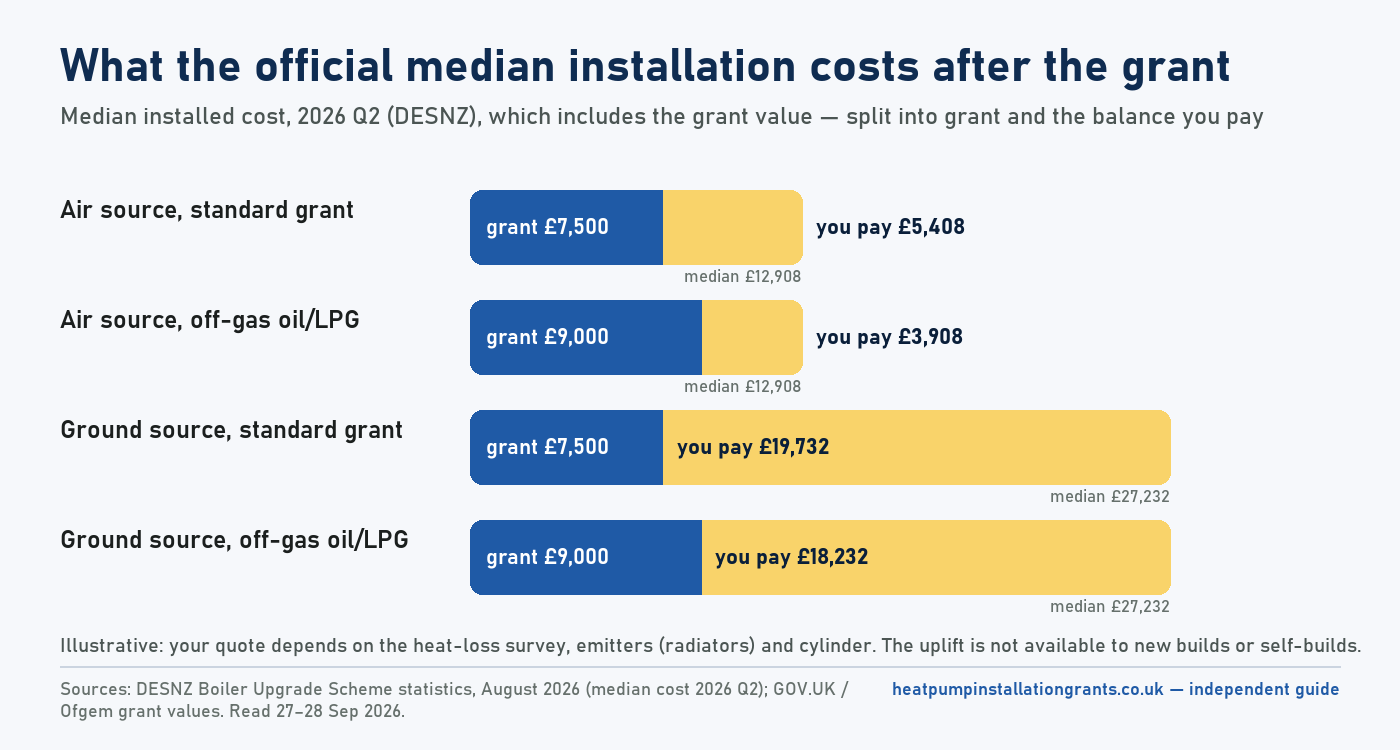
The table below is an Illustrative example, not a real quote, and not a price you should expect. It uses only the official 2026 Q3 median installed price for an air source heat pump in England and Wales (£12,826, which DESNZ states includes the grant value) and the standard grant of £7,500. It shows the structure of the last three lines of a quote. The earlier lines are left unpriced on purpose: costs for radiators, cylinders and electrics vary too widely between houses to invent a figure.
| Quote line | Illustrative figure |
|---|---|
| Survey, heat-loss calculation and design | Itemised on a real quote |
| Heat pump unit and installation | Itemised on a real quote |
| Radiators, pipework, cylinder, electrics | Itemised on a real quote |
| Commissioning, certificate, handover | Itemised on a real quote |
| Total price (2026 Q3 median) | £12,826 |
| Boiler Upgrade Scheme grant, deducted | −£7,500 |
| Balance you pay | £5,326 |
Two things to take from it. First, the grant is a line on the quote, not a cheque you receive afterwards. Second, the total in the middle row is the one to scrutinise: if a firm quotes much more or much less than the national middle, ask what is in or out of the price. A home in the £9,000 off-gas band (no mains gas, with oil or LPG heating being replaced) would see the grant line read −£9,000 instead; the £9,000 page explains the test. The median is a national figure, so the cost guide on heat pump installation cost is the place to see how the total breaks down by item.
For the national medians and the reasons a quote moves away from them, see the heat pump installation cost guide.
Red flags in a quote
- No grant line. A quote showing the full price only, or saying you will “claim the grant back”, is not how the scheme works.
- No survey behind it. A price given from photos or a phone call, with no heat-loss calculation, cannot know whether the unit fits.
- “Radiators as required”. That phrase moves the biggest uncertain cost to later. Ask for a list.
- A cylinder or electrics line left blank. Ask whether it is excluded or merely forgotten.
- A big deposit with no protection. Ask how it is held and under which code.
- A discount that expires on the day of the visit. A quote can have a validity period for good reasons. A price that disappears if you do not sign at once is a sales technique, not a cost. Ofgem’s application process has its own timescales, and none of them need a signature on the doorstep.
- Efficiency promises with no basis. A promised percentage saving without a stated efficiency and the assumptions behind it cannot be checked.
- Mismatched names. The quote, register entry and contract should name the same business.
Comparing three quotes
Build a simple grid. Down the side, list the lines in the anatomy table. Across the top, list each firm. Fill every cell from the written quote, and mark cells you could not fill as “not stated”. Then work through three passes.
- Eligibility pass. Remove any firm that fails the register check on MCS and consumer code. No amount of discount covers a lost grant.
- Scope pass. Mark where one quote includes something another leaves out: the cylinder, the radiators, the electrics, the scaffold, making good. Add an estimate for the missing items by asking each firm to price them. Only then do totals become comparable.
- Design pass. Compare flow temperatures, unit outputs against the heat-loss figures and any stated efficiency. Differences here affect running costs for years, which the running costs guide quantifies with dated tariffs.
Where two firms are close on scope and design, choose on the things a spreadsheet misses: how clearly they answered your questions, how well the survey was done, and whether the warranty terms are written plainly. Use the calculator below to see where a total sits against the official median and what the balance is after the grant, then take the actual comparison to the quotes themselves.
Where does a quote total sit?
No details needed. Change any figure to match your own quote or bills. Results are indicative — an MCS installer’s heat-loss survey and written quote are what count.
£5,326
Payable by you on this quote. The grant is deducted on the quote and invoice — you never receive it as cash.
Default quote = the official median installed cost for 2026 Q3 (DESNZ, published 29 October 2026), which includes the grant value. VAT on installing a heat pump in a home is 0% until 31 March 2027, then 5%.
Questions to put back to each installer
- Can I see the room-by-room heat-loss calculation behind the unit size?
- What is the design flow temperature, and what happens to my comfort if I need to run it higher?
- Which radiators change, and what is the cost of each?
- Is a new cylinder included? What size, and where does it go?
- Do you apply for the grant before installation, and what happens if it is refused?
- How is the deposit protected, and which consumer code applies?
- What do the product and workmanship warranties cover, and for how long?
- Who carries out the work and who is on site at commissioning?
Ofgem allows retrospective applications within 120 days of commissioning but notes they carry additional risk, because there is no guarantee the grant is paid. The fifth question tells you which route you are being offered. The application guide explains the normal order.
Deposits, VAT and paying the balance
On VAT, HMRC’s VAT Notice 708/6 sets 0% on installation in a home until 31 March 2027, then 5% from 1 April 2027. If your job straddles the change, ask which rate applies and when the supply is treated as made; the VAT page covers it. On deposits, ask what percentage is due and when, and how it is protected under the consumer code the firm belongs to. Because the grant comes off the price, the balance is what you fund. Whether you pay from savings or borrow, the options and questions to ask are below.
Paying the balance after the grant
The grant comes off the price before you pay anything, so the question is only how to fund what is left. These are the routes people use — this site does not arrange credit or recommend a lender.
| Route | How it works | What to check |
|---|---|---|
| Savings | Pay the balance on the installer’s payment schedule. You own the system outright. | How much deposit is asked for up front, and whether it is protected under the installer’s consumer code. |
| Mortgage further advance or green home loan | Some lenders offer borrowing earmarked for energy improvements, sometimes at reduced rates. | The representative APR, the total amount repayable and any fees — compare against simply paying from savings. |
| Installer-arranged credit | Some installers introduce a credit broker so the balance is paid monthly. | The lender must be authorised by the Financial Conduct Authority. Ask for the APR and total repayable in writing before you sign anything. |
| Scotland only | Home Energy Scotland offers an interest-free loan of up to £7,500 alongside its own grant (not the Boiler Upgrade Scheme). | Apply to Home Energy Scotland before work starts. |
A note on VAT (not a finance route): installers apply 0% VAT to a supply-and-install job in a home until 31 March 2027, and 5% after. Check the quote shows no VAT on the installation; equipment bought without installation is standard-rated.
Why quote comparisons go wrong
“A quote with a single total is easier to compare.”
It is easier to read and harder to compare. A single figure hides whether radiators, a hot water cylinder, electrical work and commissioning are in or out. Ask for the breakdown so you can see which firm has left things for a later “variation”.
“The lowest quote is the best value.”
Only if it describes the same job. The same house can attract quotes for different unit sizes, different amounts of emitter work and different warranties. Treat a quote far below the others as a prompt to ask what is missing, not as a win. The official 2026 Q3 median for an air source heat pump was £12,826 before the grant, so a figure far from that range deserves a question either way.
Some houses genuinely need less work, for example where radiators are already large. A low quote can be right if the survey shows why.
“I cannot judge the technical detail anyway.”
You do not have to judge the engineering. You have to check that the detail exists: a heat-loss calculation, a stated flow temperature, an itemised emitter list and a named efficiency assumption. A firm that cannot produce them has told you something.