The headline numbers
There is no official price list for heat pumps, because installers set their own prices. What does exist is a record of what grant-funded installations actually cost. Every job under the Boiler Upgrade Scheme is reported to Ofgem, and the Department for Energy Security and Net Zero (DESNZ) publishes the median installed cost each quarter. For 2026 Q3 the median was £12,826 for an air source heat pump and £34,630 for a ground source heat pump. Both medians include the value of the grant, so they are the full price before anything is deducted.
The air source median has fallen. In 2022 Q3 the median was £12,860 (£14,989 in 2026 prices), so today’s figure is 14% lower in real terms and £34 lower in cash terms. That matters because older articles quote prices from the early years of the scheme.
The Energy Saving Trust, the government-funded advice body, says the typical cost of an air source heat pump is around £12,000 (page updated 23 September 2026), and around £15,000 for ground source where the loop is buried in trenches. Those figures sit close to the DESNZ medians for air source and well below them for ground source, which is a reminder that different sources describe different mixes of jobs. This site uses the official medians as the anchor and treats every other number as context.
Two things this page does not do: it does not invent a per-item price list, and it does not quote a regional price table. Neither exists in official data, and ranges copied between websites tend to trace back to nothing. Where a number is missing, the page says so.
A note on ground source: few systems are installed each quarter and their size varies, so the median jumps around. The ground source median moves between quarters with the size of systems installed: DESNZ’s 2026 Q3 median capacity was 15 kW, against 10.5 kW in 2026 Q2 when the median cost was £27,232.
Air source, ground source, air-to-air and biomass compared
“Heat pump” covers several technologies with different costs and different grants. Only the first two have an official installed-cost median.
| Technology | Official median installed | Grant (England and Wales) | Median less grant |
|---|---|---|---|
| Air source (air-to-water) | £12,826 | £7,500, or £9,000 off-gas on oil or LPG | £5,326 (or £3,826) |
| Ground source | £34,630 | £7,500, or £9,000 off-gas on oil or LPG | £27,130 (or £25,630) |
| Air-to-air (heats air, no wet radiators) | No official median published in the sources used | £2,500, residential only | Not calculable from official data |
| Biomass boiler | No official median published in the sources used | £5,000, rural off-gas only | Not calculable from official data |
Air source (air-to-water) is what almost everyone means by a heat pump: 98% of redemptions so far. It heats water that runs through radiators or underfloor pipes and, with a cylinder, your hot water. Air source heat pump costs after the grant goes into that technology by house type.
Ground source pulls heat from a buried loop or a borehole. Median cost is 2.7 times the air source figure, and 82% of grant-funded ground source jobs are off the gas grid. The collector is the reason; see ground source heat pump costs.
Air-to-air units blow warm air around the home like a reversible air conditioner. They have been grant-eligible for residential properties since 28 April 2026, at £2,500. They do not heat water, so a home still needs a separate source of hot water. We have not found an official installed-cost median for them, so we give none.
Biomass boilers burn wood pellets or logs and qualify for £5,000 only in rural off-gas homes. They are not a heat pump, and again there is no published median in the data used here. 421 biomass boilers had been redeemed by end of September 2026.
Heat pump cost before and after the grant
The grant is deducted by the installer from the quote, so what you pay is the total less £7,500 or £9,000. At the median, the £7,500 grant covers about 58% of an air source job and about 22% of a ground source one. That is why the grant changes the decision for air source far more than for ground source.
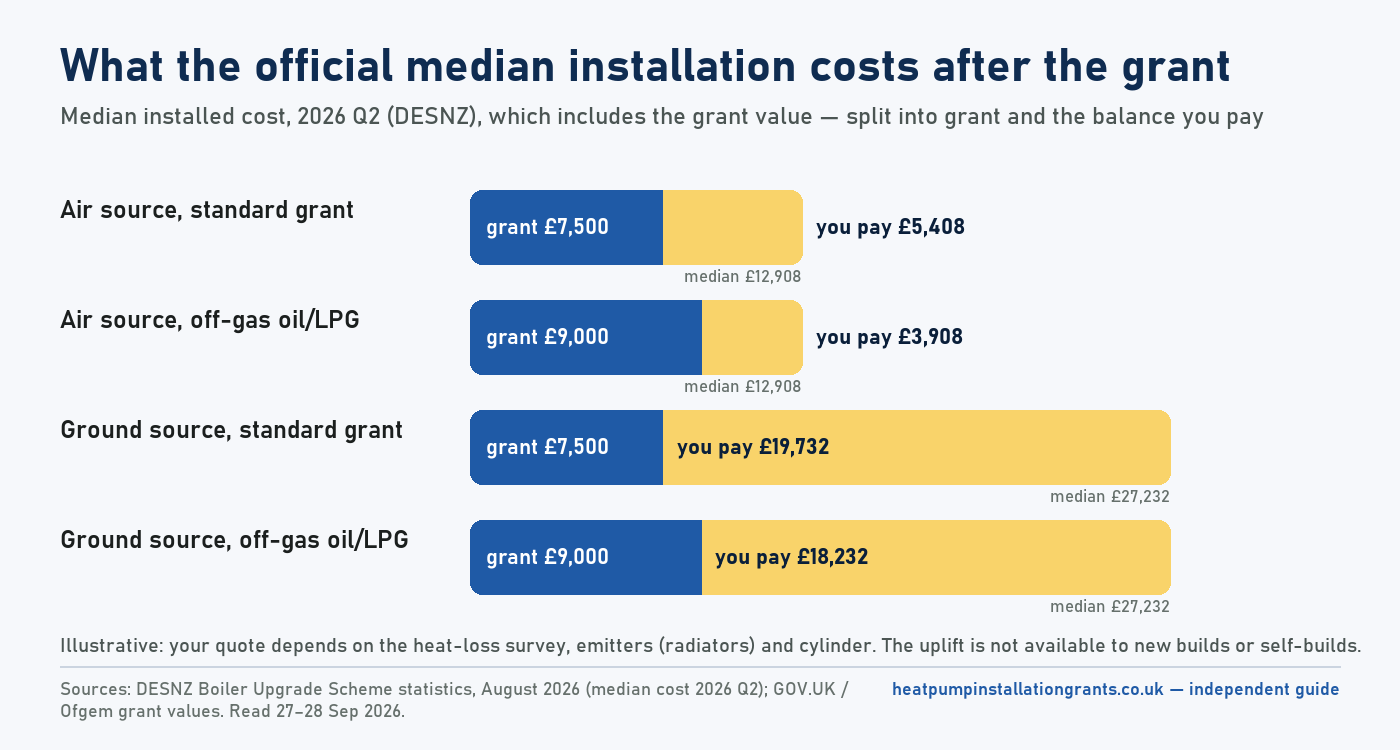
| Basis | Cost before grant | Grant | You pay |
|---|---|---|---|
| Air source, DESNZ median, mains gas | £12,826 | £7,500 | £5,326 |
| Air source, DESNZ median, oil or LPG, no mains gas | £12,826 | £9,000 | £3,826 |
| Air source, Energy Saving Trust “around” | £12,000 | £7,500 | £4,500 |
| Ground source, DESNZ median | £34,630 | £7,500 | £27,130 |
| Ground source, Energy Saving Trust trench figure | £15,000 | £7,500 | £7,500 |
Two conditions govern the grant. The £9,000 band applies only where the home has no mains gas and the heating being replaced runs on oil or LPG, for applications from 21 July 2026 to 31 March 2027; a direct-electric home off the gas grid gets £7,500. And the installer, not you, makes the application: Ofgem emails you to consent, and the grant is then taken off your invoice. The amounts are set out in heat pump grant amounts, and the route in how to apply.
Heat pump cost by type of home
There is no official price by house size: DESNZ publishes one national median per technology, not a table by bedrooms. What changes between a flat and a detached house is the heat the system has to replace, which the installer measures room by room at the survey. Use the national figures below as the starting point, then expect your quote to move up or down with the factors in the last column.
| Type of home | Starting point (air source) | After the £7,500 grant | What usually moves the quote |
|---|---|---|---|
| Flat, 1-2 bedrooms | £12,826 national median | £5,326 | Where the outdoor unit can go (flats are limited to a 0.6 cubic metres unit under permitted development), freeholder consent, cylinder space |
| Terrace or semi, 2-3 bedrooms | £12,826 national median | £5,326 | Radiator upgrades, a new hot water cylinder, the run from the outdoor unit to the house |
| Semi or detached, 3-4 bedrooms | £12,826 national median | £5,326 | Heat loss of the larger floor area, number of radiators changed, cylinder size for more occupants |
| Detached, 4+ bedrooms | £12,826 national median | £5,326 | Higher heat demand can mean a larger unit or two units (permitted development allows 2 on a detached house); ground source becomes worth pricing (£34,630 median) |
| Off-gas home on oil or LPG | £12,826 national median | £3,826 on the £9,000 band | The £9,000 band applies only with no mains gas connection, for applications up to 31 March 2027 |
If your quote sits well above the national middle, ask the installer which of these items drives it; if it sits well below, ask what is left out. The form below asks the questions that matter for that comparison.
Ask about your heat pump cost after the grant
Tell us the home, what heats it now and where you are with quotes. Your enquiry comes to SEO-DONS LTD, the publisher of this guide, and we reply by email. We are not an installer, Ofgem or the government, and there is no charge.
What is inside a heat pump installation quote
Official data records a single total per job, so no authority publishes a price for each line. What we can say reliably is which lines a complete quote should contain, because Ofgem’s guidance requires the quote to show the grant and the balance, and the MCS standards require a proper design. A good quote lets you see these separately:
- Heat-loss survey and system design. A room-by-room calculation of how much heat the home loses, used to size the unit and the radiators. A quote that sizes by floor area alone is a guess.
- The outdoor unit, its base or wall brackets, and the refrigerant circuit.
- The hot water cylinder. Most homes switching from a combi boiler need one, plus somewhere to put it. Homes that already have a suitable cylinder may keep it.
- Radiators and pipework. Heat pumps run at lower flow temperatures than boilers, so some rooms may need larger radiators or underfloor heating. This is the line with the widest range of outcomes, from nothing to most of the house.
- Electrical work, including any change to your consumer unit and the notification to your network operator.
- Controls and commissioning, the MCS certificate and handover.
- Removal of the old boiler, and for oil or LPG homes what happens to the tank.
- Groundworks (ground source only): trenches or boreholes, collector pipework and reinstatement of the garden.
- The grant as a deduction and the balance payable, plus the VAT treatment.
Our heat pump quotes checklist turns that list into questions you can put to each installer, and hot water cylinders and sizing and radiators explain the two lines that move the total most.
Why quotes for similar houses differ
Heat pump pricing is not like boiler pricing, where one box fits most homes. Five factors explain most of the spread:
- Heat loss. A draughty house needs a larger unit and larger emitters. The grant no longer requires insulation first (that condition was removed 8 May 2024), but fabric improvements can shrink the whole system.
- Emitters. Four radiators or fourteen; or underfloor heating. This alone can be the biggest single swing.
- Hot water. Whether a new cylinder is needed, its size, and the pipework to reach it.
- Access and siting. Long pipe runs, difficult walls or a unit positioned away from the house to stay within the 37.0 dB(A) noise limit add labour. See heat pump planning permission.
- Choice of installer and scope. Brand, warranty, who handles the grant paperwork and how carefully the design is done.
VAT on a heat pump installation
Installing a heat pump in residential accommodation is zero-rated until 31 March 2027, then 5% from 1 April 2027 (HMRC VAT Notice 708/6, read 8 October 2026). The relief applies when the installer supplies and installs together; equipment bought on its own is standard-rated. As pure arithmetic, 5% of the air source median would be about £641 if the same price were charged with VAT on top, but the median’s own VAT treatment is not stated, so treat that as scale, not a forecast. Dates and conditions are in VAT on heat pumps.
Quick estimate
For a fuller version with running costs as well, use the heat pump cost calculator.
The estimator below uses only the official medians in this guide. It gives the balance after the grant for a median job and nothing more; your own quote will differ, and it is the quote that counts.
Heat pump cost estimator (official medians)
Pick a system for a guide figure built from the official median installed costs. It is indicative only — an installer's itemised quote is the only real price.
Median balance after grant
£5,326balance after £7,500
Timing: voucher valid 3 months
Single figure taken from the official median installed cost, after the grant. Your price depends on the house, and only an installer's itemised quote confirms it.
Check your eligibilityIf the system is in and the bills look wrong, start with why is my heat pump electricity bill high: the design line items above are usually where the answer lies.
Installation cost is half the picture
A heat pump’s price tag is paid once; running costs arrive every month. At the Ofgem cap for 1 October to 31 December 2026, a home using 12,000 kWh of heat a year would spend about £1,053 with a heat pump at a seasonal efficiency of 3, against about £1,063 on gas (plus a £108 gas standing charge) and about £1,566 on oil. That is an illustrative model, not your bill. The assumptions are set out in heat pump vs boiler running costs, and the verdict by situation is in is a heat pump worth it?
Is my quote reasonable?
Three tests. First, compare the total with the £12,826 median for a house like yours: well above is not wrong, but the quote should explain why. Second, make sure it itemises the design, unit, cylinder, radiators and commissioning so you can compare it to others. Third, check the installer is on the MCS register and a member of a consumer code, and that the grant appears as a deduction (see MCS installers). If your home is off the gas grid on oil or LPG, also check it shows £9,000 rather than £7,500; the off-gas grant explains the test.
Paying the balance after the grant
The grant comes off the price before you pay anything, so the question is only how to fund what is left. These are the routes people use — this site does not arrange credit or recommend a lender.
| Route | How it works | What to check |
|---|---|---|
| Savings | Pay the balance on the installer’s payment schedule. You own the system outright. | How much deposit is asked for up front, and whether it is protected under the installer’s consumer code. |
| Mortgage further advance or green home loan | Some lenders offer borrowing earmarked for energy improvements, sometimes at reduced rates. | The representative APR, the total amount repayable and any fees — compare against simply paying from savings. |
| Installer-arranged credit | Some installers introduce a credit broker so the balance is paid monthly. | The lender must be authorised by the Financial Conduct Authority. Ask for the APR and total repayable in writing before you sign anything. |
| Scotland only | Home Energy Scotland offers an interest-free loan of up to £7,500 alongside its own grant (not the Boiler Upgrade Scheme). | Apply to Home Energy Scotland before work starts. |
A note on VAT (not a finance route): installers apply 0% VAT to a supply-and-install job in a home until 31 March 2027, and 5% after. Check the quote shows no VAT on the installation; equipment bought without installation is standard-rated.
Cost objections, answered with the numbers
“A heat pump costs three times a boiler, so it is not worth it.” (a common claim; there is no official boiler median to test it against)
Before the grant the gap is real. After it, the typical air source job leaves about £5,326 to pay (£3,826 for an off-gas oil or LPG home on the £9,000 band). Ask for a like-for-like boiler quote with a cylinder and radiator work and compare the two final numbers, not the headline prices.
If your gas boiler is young and your home is already well insulated, replacing it early may never pay back on cost alone. Waiting is a legitimate choice.
“Quotes for the same house are wildly different, so they must all be a rip-off.”
Most of the spread is scope: how many radiators change, whether a cylinder is added, how far the pipes run, and who designs the system. Asking each installer for the heat-loss figure, the design flow temperature and an itemised list turns three confusing totals into three comparable ones.
“The government figure includes the grant, so my price will be lower.”
Your price is the median before the grant comes off, not after. The £12,826 median includes the £7,500 that is then deducted from the quote.
The median is the middle job, so a large or poorly insulated house can sit well above it.