The idea in one paragraph
Even when it feels cold outside, the air and the ground still hold usable heat. A heat pump takes that low-temperature heat, raises its temperature using a compressor, and releases it into your central heating system. It does this with the same refrigeration cycle found in a fridge, running in the other direction. That is the whole trick, and it explains most of what people notice about heat pumps: they run for longer at gentler temperatures, they need electricity rather than gas or oil, and they can be efficient because most of the energy delivered as heat was already outside your house.
The rest of this page takes each stage in turn. If you only want the money side, the Boiler Upgrade Scheme guide covers the grant and the installation cost page covers prices.
The four-stage cycle
The Energy Saving Trust describes the refrigeration cycle as a four-step process. A sealed circuit holds a refrigerant, a liquid chemical similar in principle to the one in a fridge. It moves around the circuit changing between liquid and gas, picking up and dropping off heat as it does.
| Stage | What happens | Where it happens |
|---|---|---|
| 1. Evaporation | Heat from the air or ground passes to the refrigerant through a heat exchanger. The refrigerant absorbs it and evaporates into a low-pressure, low-temperature gas. | Outdoor unit (air source), or a heat exchanger fed by the buried ground loop (ground source) |
| 2. Compression | An electric compressor squeezes the gas. As the pressure rises, so does the temperature. | Inside the heat pump unit |
| 3. Condensation | The hot gas gives up its heat to the water circuit that feeds your radiators, underfloor heating and cylinder. The refrigerant cools back into a liquid. | Second heat exchanger, joined to your heating pipework |
| 4. Expansion | The liquid passes through an expansion valve, which lowers its pressure and cools it below the outside temperature, ready to collect heat again. | Inside the heat pump unit |
Only stage two uses much electricity. The compressor, fans and pumps are the heat pump’s running load; everything else is the refrigerant carrying heat that was already free in the environment.
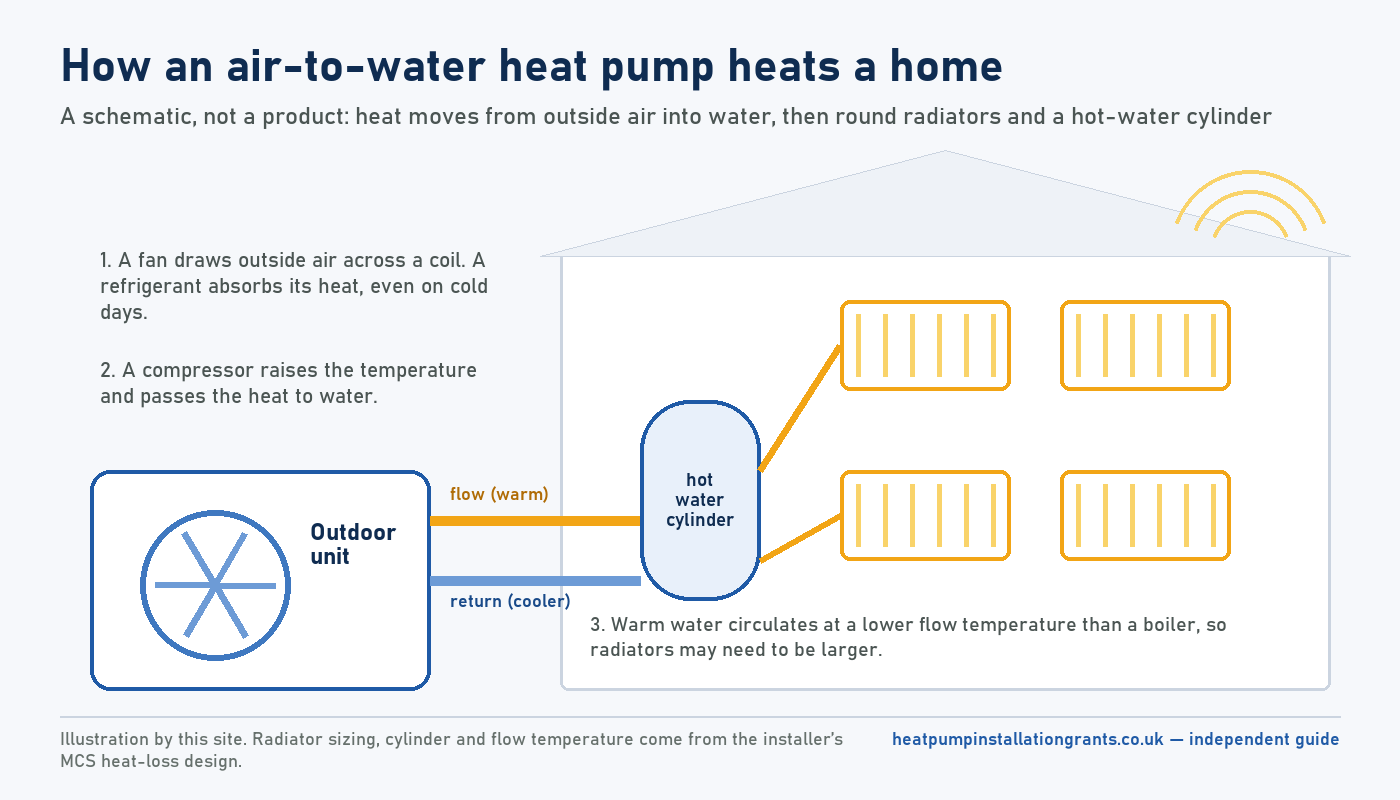
What is installed in your home
A typical air source installation has three visible parts. The outdoor unit contains the fan and heat exchanger; the Energy Saving Trust likens a standard unit to two wheelie bins side by side. A hot water cylinder stores heated water, because a standard heat pump does not supply hot water on demand like a combi boiler, and it can usually fit in a cupboard of at least 80cm x 80cm. And your emitters, the radiators or underfloor heating, release the heat into each room.
There are two layouts. A monobloc keeps all the refrigerant components in the outdoor unit and sends water through pipes to the house. A split system divides the refrigerant parts between an outdoor and an indoor unit. The Energy Saving Trust says monobloc systems are more common because they are cheaper and quicker to install and take less indoor space, while split systems can be slightly more efficient because part of the heat transfer happens inside, where it is warmer.
Your installer sizes the system from a room-by-room heat-loss calculation, not from the old boiler’s output. If you want to see what that involves, the sizing and radiators guide goes through it, and the heat pump survey guide shows how to prepare for the visit.
Air source, ground source and air-to-air
Air source (air-to-water) is the most common domestic type in the UK. A fan pulls outdoor air over the evaporator, and the heat goes into water. Ground source circulates a mixture of water and antifreeze, called brine, round buried pipes (laid in trenches or dropped down boreholes), and a heat exchanger passes the heat to the refrigerant. Air-to-air units heat rooms by blowing warm air, with no radiators or hot water cylinder, and are a separate grant category. The grant-eligible types and amounts are on the grant amounts page, and the head-to-head between the two main types is in the air source vs ground source guide.
Why it uses less electricity than the heat it gives
The Energy Saving Trust says that for every unit of electricity used, a heat pump can give three to four times as much heat, written as 300 to 400%. A new gas or oil boiler converts roughly 85 to 90% of its fuel into usable heat, so even the best boiler delivers less than one unit of heat per unit of fuel. The ratio for a heat pump is called the Coefficient of Performance (CoP); the whole-year version is the seasonal performance factor. The efficiency guide explains both and shows what the field trial measured: across 428 air source heat pumps in the Electrification of Heat project, the median seasonal performance factor (SPFH2) was 2.93, so real homes land below the 3-to-4 range quoted for ideal conditions.
Efficiency is not the same as cheap. Electricity costs more per unit than gas, so the running bill depends on both the efficiency and the tariff. The running costs page works it through at the current Ofgem cap.
What this means for your house
Because the heat arrives at a lower water temperature than from a gas boiler, the Energy Saving Trust notes that radiators often run at 35 to 45°C, so some rooms may need bigger radiators, and the heating tends to be left on for longer at a steady level. That is a design question for the survey rather than a reason to rule a heat pump out: the Energy Systems Catapult trial, which installed 742 heat pumps, found no property type or architectural era that is unsuitable for a heat pump.
- Check you have somewhere to site an outdoor unit and a cupboard for a cylinder.
- Expect the installation itself to take around 3 days, per the Energy Saving Trust, and longer if pipework or underfloor heating is involved.
- Ask for the installer’s heat-loss calculation and the predicted seasonal efficiency in writing.
Where to go from here
Heat pumps are common enough now that the official median installed price for an air source system in 2026 Q3 was £12,826 including the grant, or about £5,326 after a £7,500 grant (DESNZ, September 2026 statistics; see the air source cost page). The grant is claimed by your installer, who applies on your behalf; the how-to-apply guide shows the order of events. To find out whether your home qualifies, use the eligibility checker, which gives a result without any contact details.